
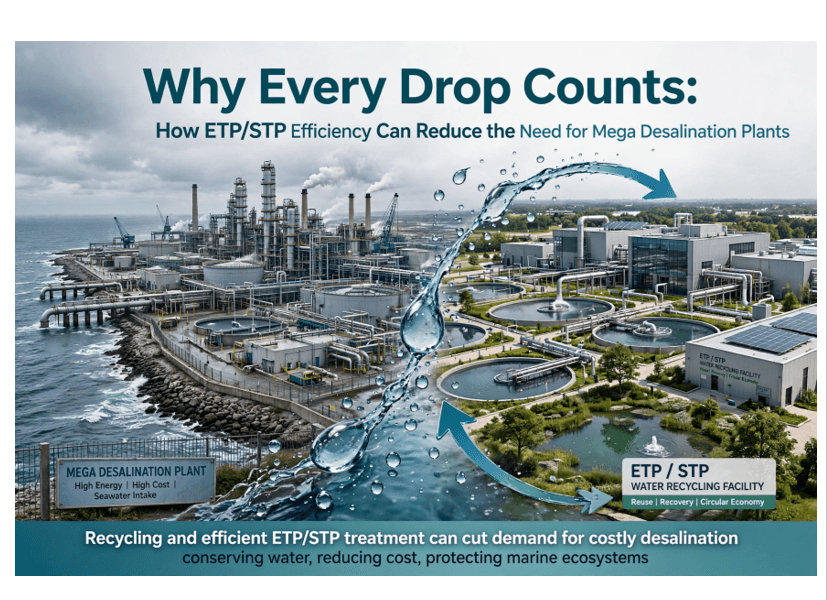
Mumbai is building India's most expensive water project. A Rs 4,007-crore desalination plant in Manori that will convert seawater into 400 million liters of drinking water daily (400 MLD) by 2029. It’s a massive engineering feat.
But it also raises a critical question - Do we really need to go to the sea for water, when we are throwing away thousands of crores worth of water every day on land?
The answer lies in three letters: ETP, STP, and WTP.
The Real Cost of Making Seawater Drinkable
Desalination sounds like a perfect solution for a coastal city like Mumbai. Unlimited seawater, unlimited drinking water. But the reality is different.
1. High Energy, High Cost: To treat 1 liter of seawater, a desalination plant uses 3 to 4 units of electricity, compared to just 0.3 units for a normal Water Treatment Plant (WTP). This makes desalinated water 4x more expensive.
2. Environmental Impact: For every 100 liters of seawater treated, 40 liters of drinking water is produced and 60 liters of highly salty brine is dumped back into the sea. This brine destroys marine ecosystems near Manori and Gorai.
3. It’s a Linear Solution: Desalination takes water from the sea, uses it once, and throws it as sewage. It doesn't solve the problem, it just adds a new, expensive water source.
So what is the alternative? A Circular Water Economy.
The Water We Already Have But Waste
Mumbai supplies about 3,800 MLD of water daily. Here’s what happens to it:
25-30% is lost in leakage, theft, and old pipelines. That's nearly 1,000 MLD wasted daily. The city generates over 2,500 MLD of sewage. More than 80% of this goes untreated or partially treated into the sea.industries in and around Mumbai consume another 500 MLD of fresh water and discharge 80% as industrial wastewater. If we add it up, Mumbai wastes more water than the Manori desalination plant will produce. We don't have a water shortage problem. We have a water management problem.
This is where ETP and STP efficiency changes the game.
How Efficient ETP/STP Can Replace a Desalination Plant
Instead of creating new water, what if we reuse every drop we already have?
1. STP Reuse - Turning Sewage into a Resource
A modern Sewage Treatment Plant (STP) with MBBR, MBR, and Tertiary Treatment can treat sewage to a quality that is safe for non-potable use.
If Mumbai treats and reuses just 50% of its 2,500 MLD sewage for gardening, toilet flushing, car washing, construction, and industrial cooling - it will save 1,250 MLD of fresh drinking water. That is THREE TIMES the capacity of the Manori desalination plant, at one-third the cost.
Keywords: Sewage Treatment Plant, STP for Housing Societies, MBR Technology, Water Reuse, Mumbai Water Crisis
2. ETP & ZLD - Zero Liquid Discharge for Industries
Industries are the biggest consumers of fresh water. An efficient Effluent Treatment Plant (ETP) with RO and ZLD (Zero Liquid Discharge) system can recover up to 95% of wastewater.
An industrial unit using 100 KLD of water can recover 95 KLD every day. It doesn't need fresh water anymore. Multiply this by thousands of factories in MIDC, Taloja, and Navi Mumbai, and you save another 400 MLD easily.
Keywords: Effluent Treatment Plant, Industrial ETP, Zero Liquid Discharge, ZLD Plant, Wastewater Recycling
3. WTP Efficiency - Stop Treating Water Twice
Many cities treat water in a WTP, supply it, and then treat it again as sewage. A highly efficient WTP with smart filtration, chemical dosing, and automation reduces chemical consumption by 30% and increases water recovery.
Efficient WTP operation is the first step to ensuring Every Drop Counts.
Economics: Which is Cheaper?
Let's compare: Feature Desalination Plant (Manori)STP/ETP Recycling Model Capital Cost Rs 4,007 Cr for 400 MLDRs 1,500-2,000 Cr for 1,200 MLD reuse Running Cost Rs 25-30 per 1000 liters Rs 8-12 per 1000 liters Power Consumption Very High Low to Medium Environmental Impact High Brine Pollution Positive - Less Pollution The numbers are clear. Recycling is cheaper, greener, and faster to implement.
The Way Forward: Desalination as Backup, Not Primary
We are not saying Mumbai should not build the Manori desalination plant. For a growing metropolis, water security is critical. But desalination should be the last resort, not the first plan.
The first plan should be:
Make STP reuse mandatory for all new buildings and townships. Enforce ZLD for all industries above 50 KLD consumption. Fix leakages with smart water management systems. Promote Decentralized WTP/STP/ETP plants instead of one mega project. If we achieve 60% efficiency in our existing ETP and STP plants, India will never need another mega desalination plant.
Conclusion
The Manori project proves one thing - water is now more valuable than oil. At AN Engineers & Chemicals, we believe in our motto: Every Drop of Water Counts.
Instead of running to the sea, it's time to value the water we already have. An efficient ETP and STP doesn't just treat water - it creates a new water source, right in your backyard.
If you are a builder, industry owner, or housing society looking to cut your water bill by 70% and become water-positive, it's time to invest in high-efficiency water recycling.
The sea will always be there. Let's first save the water we have.