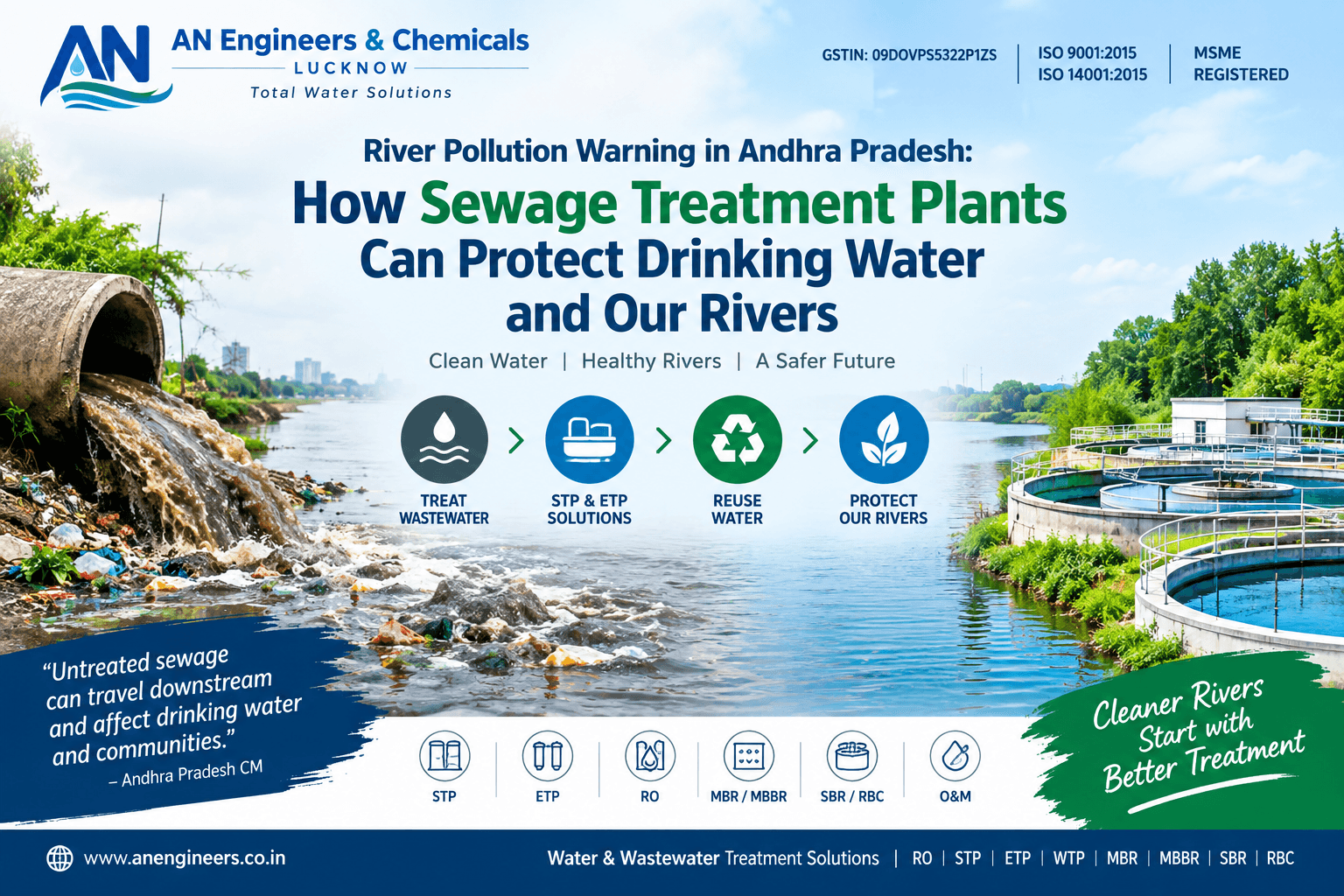
India's rivers are not only natural ecosystems—they are also important sources of drinking water, irrigation, industry and livelihoods. When untreated sewage, industrial wastewater and other waste enter a river, the impact does not necessarily remain limited to the location where the pollution occurs. Contaminants can travel downstream and affect communities, agriculture and aquatic ecosystems.
A recent warning from Andhra Pradesh Chief Minister N. Chandrababu Naidu has once again highlighted this important issue. Speaking at the Swarnandhra–Swachh Andhra Awards-2026 in Vijayawada, he called for preventing untreated sewage and waste from entering the Krishna and Godavari rivers, noting that downstream populations depend on river water for drinking purposes.
Why Untreated Wastewater Is a Serious Problem
Domestic sewage and industrial wastewater can contain organic matter, suspended solids, nutrients, oils, chemicals and microorganisms.
If this wastewater is discharged without appropriate treatment, it can contribute to:
Increased BOD and COD
Higher suspended solids and turbidity
Reduction of dissolved oxygen in rivers
Growth of unwanted algae and microorganisms
Contamination of surface and groundwater
Damage to aquatic ecosystems
Increased treatment requirements for downstream drinking-water systems
Public-health and environmental concerns
The problem becomes particularly important in areas where communities depend directly or indirectly on river systems for their water requirements.
A Recent Example from the Godavari Region
A June 2026 report on pollution in the Vasishta Godavari at Narasapuram highlighted the consequences of inadequate wastewater infrastructure. The report stated that around 3 MLD of wastewater was reportedly being discharged directly into the river in the absence of a sewage treatment plant. The Andhra Pradesh Pollution Control Board recommended STPs for several towns, including Palakollu, Narasapuram, Bhimavaram and Tanuku.
This illustrates an important principle:
Wastewater should be treated at its source before it becomes a river-pollution problem.
What Can Be Done?
River pollution cannot be solved by river cleaning alone. The most effective approach is to control pollution before wastewater reaches the river.
1. Install and Upgrade Sewage Treatment Plants
Urban local bodies, institutions, hospitals, hotels and large residential developments should have suitable Sewage Treatment Plants (STPs) based on their wastewater quantity and characteristics.
Depending on the application, technologies such as:
MBBR
SBR
MBR
RBC
Conventional biological treatment
Tertiary treatment
can be considered.
The correct technology should be selected after studying wastewater characteristics, discharge standards, available space, operating requirements and reuse objectives.
2. Treat Industrial Effluent Before Discharge
Industrial wastewater can contain chemicals, oils, high organic loads, suspended solids and other contaminants.
Industries should operate suitable Effluent Treatment Plants (ETPs) and ensure that treated effluent meets applicable discharge requirements before disposal or reuse.
For industries with variable or complex wastewater, treatment may include:
Collection → Screening → Equalization → pH Correction → Chemical Treatment → Biological Treatment → Clarification → Filtration → Disinfection / Tertiary Treatment
The actual treatment sequence should be designed according to the wastewater analysis.
3. Reuse Treated Wastewater
One of the most effective ways to reduce pressure on freshwater resources is to reuse properly treated wastewater.
Depending on the quality achieved, treated wastewater can potentially be used for:
Gardening and landscaping
Toilet flushing
Cooling-tower make-up
Construction activities
Road washing
Certain industrial processes
Other non-potable applications
Where higher-quality water is required, additional tertiary treatment, filtration, disinfection or membrane treatment may be incorporated.
4. Regular Water Quality Monitoring
Installing a treatment plant is only the first step.
Regular monitoring of parameters such as:
pH
BOD
COD
TSS
TDS
Oil & Grease
Ammoniacal Nitrogen
Total Nitrogen
Phosphate
Microbiological parameters
Helps identify treatment problems before they become larger environmental issues.
Online monitoring can also be considered for suitable applications and regulatory requirements.
5. Stop Pollution at the Source
Recent action by the Andhra Pradesh authorities regarding aqua-processing units also demonstrates the importance of source-level control. In September 2026, officials reported inspections and sampling of aqua-processing and pre-processing units, with attention to parameters including pH, TSS and BOD.
This approach is important because pollution prevention is generally more effective when the source is identified and controlled before wastewater reaches a common drain, canal or river.
6. Maintain STPs and ETPs Properly
A treatment plant cannot deliver consistent performance without proper operation and maintenance.
Common reasons for poor STP/ETP performance include:
Blower failure
Insufficient aeration
Poor sludge management
Improper chemical dosing
Damaged pumps
Blocked pipelines
Poor biological activity
Inadequate monitoring
Lack of preventive maintenance
Regular inspection, preventive maintenance and timely replacement of worn components can significantly improve plant reliability.
The Role of Businesses and Institutions
River protection is not only the responsibility of government authorities.
Hotels, hospitals, industries, educational institutions, residential societies and commercial establishments can contribute by:
Treating wastewater → Monitoring treatment quality → Reusing treated water → Preventing illegal discharge → Maintaining treatment systems
Every organization generating wastewater has an opportunity to reduce its environmental footprint.
AN Engineers & Chemicals: Water & Wastewater Solutions
At AN Engineers & Chemicals, Lucknow, we work in the field of water and wastewater treatment and provide solutions for RO, STP, ETP, WTP and related treatment systems.
Our services include:
STP design and consultancy
ETP design and consultancy
RO plant solutions
MBBR-based treatment systems
MBR systems
SBR systems
RBC-based treatment
Sewage and effluent treatment solutions
Plant installation and commissioning
Operation & Maintenance
Water and wastewater treatment consultancy
Filtration and tertiary treatment solutions
Our approach is to understand the wastewater quantity, characteristics, and treatment objective and site requirements before recommending a suitable treatment solution.
From Wastewater to Reusable Water
The objective should not simply be to move wastewater from one location to another.
The objective should be:
Reduce → Treat → Monitor → Reuse → Protect
By improving wastewater treatment and encouraging water reuse, we can reduce the pollution load entering our rivers and help conserve freshwater resources.
Conclusion
The recent warning regarding untreated sewage entering the Krishna and Godavari rivers is a reminder that river pollution is not only a local issue. Wastewater discharged upstream can have consequences for communities and ecosystems downstream.
The solution requires a combination of:
Effective STPs + ETPs + Regular Monitoring + Proper O&M + Wastewater Reuse + Source-Level Pollution Control
Protecting rivers begins before wastewater reaches the river.
Treat wastewater today to protect tomorrow's water resources.