India is facing a growing water challenge. Across cities, industries, hospitals, institutions and residential communities, increasing demand for freshwater is putting pressure on already stressed water resources.
At the same time, changing rainfall patterns are making water availability less predictable. Some regions may experience prolonged periods of insufficient rainfall, while others face intense rainfall, flooding and urban waterlogging within a short period.
This changing water landscape highlights an important question:
Are we managing water efficiently enough for the future?
The solution is not only to conserve freshwater. We also need to fundamentally change the way we manage wastewater.
Instead of considering wastewater as a waste product that must simply be treated and discharged, we need to recognize its potential as a valuable resource.
Why Is Water Management Becoming More Important in India?
Water is essential for every part of society and the economy. Domestic consumption, agriculture, healthcare, manufacturing, hospitality, infrastructure and commercial activities all depend on reliable water supplies.
However, several factors are increasing pressure on India's water resources:
Increasing urban population
Industrial expansion
Growing freshwater demand
Groundwater extraction
Changing rainfall patterns
Reservoir storage pressure
Water pollution
Inefficient water consumption
Inadequate wastewater reuse
This means future water security will depend not only on finding new water sources but also on using existing water resources more efficiently.
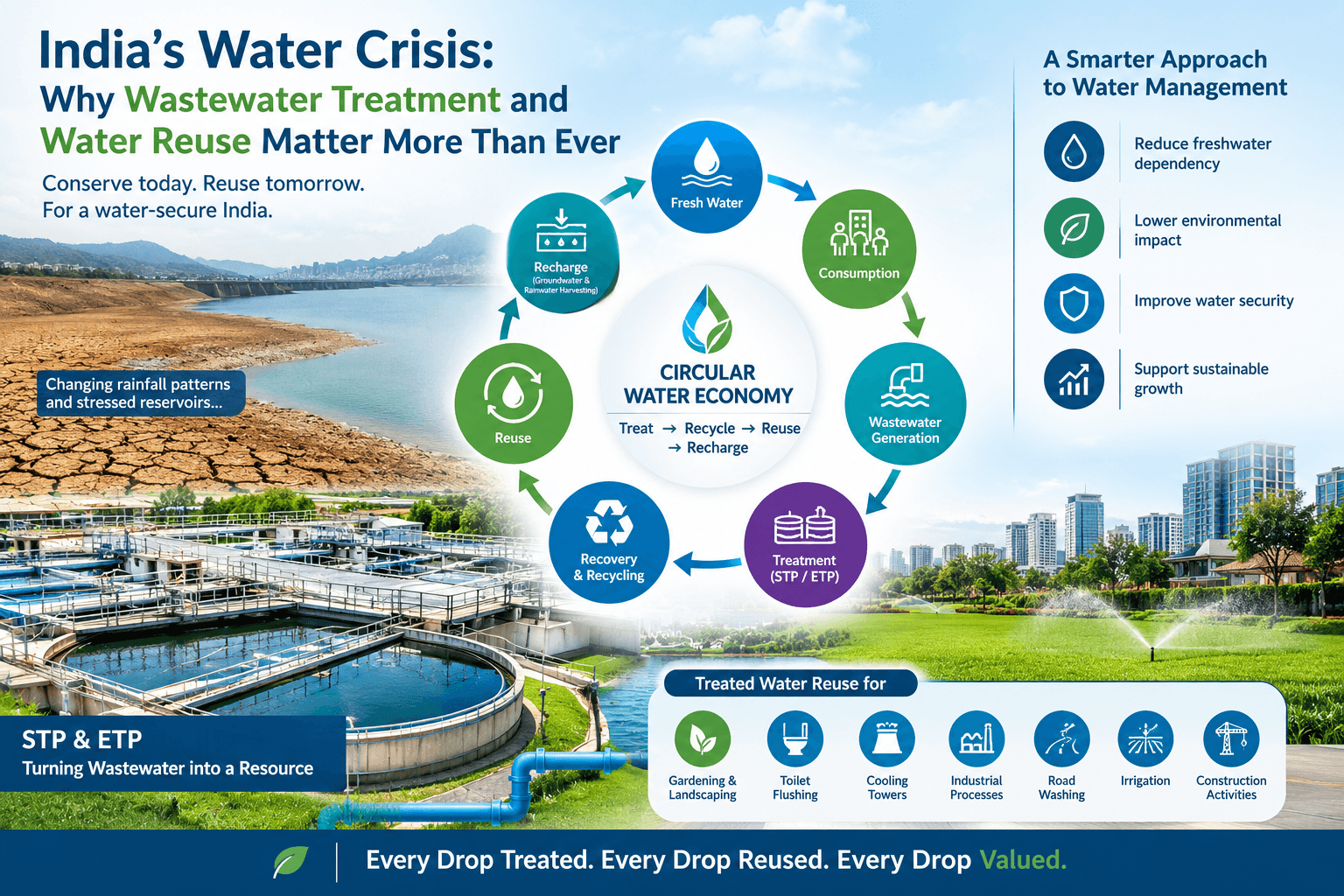
A sustainable water strategy must therefore focus on conservation, treatment, recycling, reuse and recharge.
Wastewater Is a Resource, Not Just Waste
Every day, large quantities of wastewater are generated by homes, hotels, hospitals, industries, commercial buildings and institutions.
Traditionally, the wastewater management approach has been:
Use Water → Generate Wastewater → Treat → Discharge
A more sustainable approach is:
Use Water → Generate Wastewater → Treat → Recover → Reuse
This shift from disposal to reuse can help reduce freshwater consumption and improve overall water efficiency.
Depending on the treatment quality and application, properly treated wastewater can potentially be reused for:
Gardening and landscaping
Toilet flushing
Road washing
Construction activities
Cooling systems
Industrial applications
Irrigation
Other suitable non-potable applications
The exact reuse application should always be determined by the required water quality, applicable regulations and site-specific conditions.
Importance of STP & ETP
Sewage Treatment Plants (STPs) help treat domestic wastewater, while Effluent Treatment Plants (ETPs) are designed for industrial wastewater. Both play an important role in reducing pollution and supporting water recycling.
Modern technologies such as MBBR, MBR, filtration, UF, RO and disinfection systems can be selected according to wastewater characteristics and the required treated-water quality.
Building a Circular Water Economy
India needs to move from a “use and discharge” model towards a “use, treat and reuse” approach.
Water conservation should work alongside wastewater recycling, rainwater harvesting and groundwater recharge to create more resilient water-management systems.
The Future of Water Is Circular
Conserve → Treat → Recover → Reuse → Recharge
At AN Engineers & Chemicals, we believe sustainable water management requires practical, efficient and application-specific solutions for sewage treatment, effluent treatment, water recycling and wastewater management.
Every Drop Treated. Every Drop Reused. Every Drop Valued.